
How to Prevent Premature Fatigue Failure in Roller Screw Actuators: An Engineering Guide
Learn why roller screw actuators fail prematurely, how spalling, brinelling, galling, misalignment, and lubrication gaps occur, and how to prevent them.
When an electromechanical linear actuator fails unexpectedly in a high-duty production environment, the cascading costs are immense. Beyond the immediate expense of replacing a heavily engineered planetary roller screw, the true financial impact lies in unplanned downtime, halted assembly lines, and missed delivery SLAs. While roller screws are inherently designed to handle substantially higher loads and shock capacities than traditional ball screws—due to their vastly increased contact points—they are not immune to physics. If improperly specified, poorly lubricated, or misaligned, they will suffer from premature fatigue failure long before their theoretical L10 lifespan is reached.
Bottom Line up Front (BLUF): The vast majority of premature failures in roller screw actuators are not caused by manufacturing defects, but by a misalignment between the theoretical application data provided during the RFQ stage and the harsh realities of the actual operational environment. Issues such as micro-oscillations leading to false brinelling, lubrication starvation under high speeds, and unaccounted shock loads consistently ruin otherwise perfectly manufactured screws.
This comprehensive guide bridges the gap between theoretical load-life calculations and practical field survival. Designed for both engineering teams sizing the actuators and procurement professionals evaluating supplier warranties and Total Cost of Ownership (TCO), this article breaks down exactly how and why fatigue failure occurs, and outlines the precise steps required to prevent it.
(Last Updated: July 18, 2026)
Scope and limits (Global, July 2026): This guide applies to planetary roller screw actuators used in industrial electromechanical axes, servo presses, high-force automation, and hydraulic-replacement projects. It focuses on screw, nut, roller, sealing, alignment, and lubrication failure modes; it does not diagnose motor, drive, gearbox, brake, or controls failures. Treat the ranges and rules of thumb below as an engineering pre-check before supplier sizing, not as a substitute for manufacturer-specific load-life calculations, grease compatibility data, and validated machine test results.
1. The Anatomy of Roller Screw Wear: Contact Mechanics
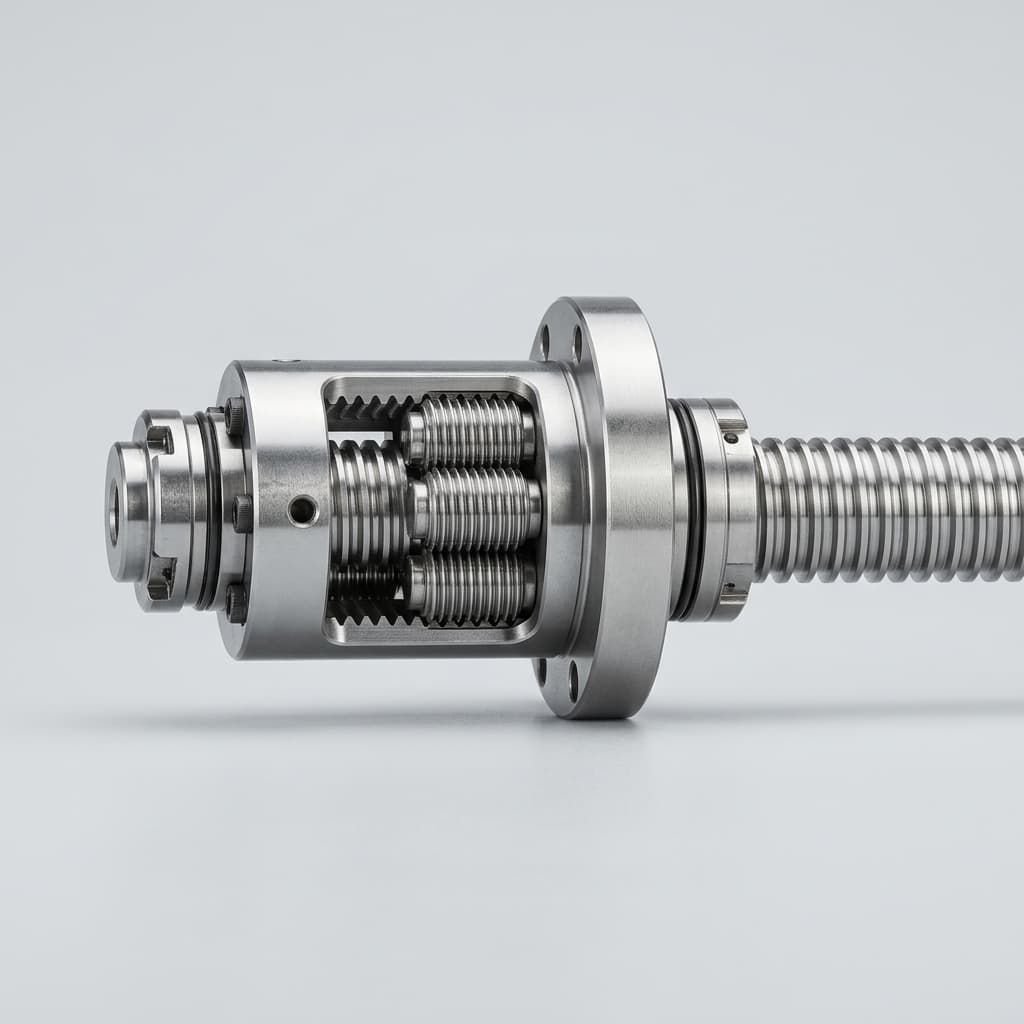
To understand why a roller screw fails, we must first look at its internal geometry. Unlike a ball screw, which utilizes recirculating spherical bearings, a planetary roller screw uses threaded cylindrical rollers that orbit a central threaded shaft. This design creates a massive amount of line contact (as opposed to point contact), spreading the load over a significantly larger surface area.
However, this increased surface area introduces a complex tribological challenge. While the primary motion is rolling, the complex geometry of the planetary threads induces a small but non-negligible amount of sliding friction at the contact interfaces. Recent 2026 studies in compliant planetary roller screws demonstrate that the sliding coefficient (mu) at the roller-to-screw interface is the most sensitive parameter dictating the fatigue lifespan limit.
When the protective elastohydrodynamic lubrication (EHL) film breaks down—whether due to high heat, extreme pressure, or lack of maintenance—this sliding friction results in localized micro-welding and subsequent material tear-out.
2. The 6 Primary Failure Modes in Roller Screw Actuators
To effectively troubleshoot or prevent failure, you must be able to accurately identify the root cause based on the physical symptoms. Throwing more grease at a broken actuator is useless if the underlying cause is a shock load exceeding the static load rating.
The following table breaks down the six most common failure modes encountered in heavy industry, their visual signatures, and their root causes.
| Failure Mode | Visual Signature / Symptom | Primary Root Cause | Prevention Strategy |
|---|---|---|---|
| 1. Subsurface Fatigue (Spalling) | Flaking, pitting, or cratering of the thread surfaces on the shaft or rollers. High audible noise and vibration. | End of natural L10 fatigue life; or continuous operation at loads exceeding the dynamic capacity. | Properly calculate L10 life. Upsize the actuator or reduce duty cycle. |
| 2. True Brinelling | Distinct, evenly spaced indentations or dents on the thread flanks matching the roller pitch. | A massive shock load or impact while the actuator is stationary, exceeding the Static Load Rating (C0). | Add mechanical shock absorbers, tune servo motion profiles, or upsize for C0. |
| 3. False Brinelling | Wear marks or depressions that look like brinelling, accompanied by red/brown oxidation (fretting corrosion). | Micro-vibrations or very short stroke oscillations while stationary. Lubricant is squeezed out without redistributing. | Program "lubrication strokes" into the PLC. Use grease formulated for fretting resistance. |
| 4. Galling & Smearing | Smeared, torn, or melted metal transferred between threads. Sudden actuator seizure. | Complete breakdown of the lubrication film due to high speeds, high temperatures, or absolute lube starvation. | Strict adherence to relubrication intervals. Monitor operating temperatures. |
| 5. Contamination Wear | Dull, matte finish on threads. Accelerated dimensional wear causing increased backlash. | Ingress of hard particles (metal chips, dust, sand) due to failed rod seals or breathers. | Specify IP69K sealing, use protective bellows, or implement positive air purge. |
| 6. Misalignment Binding | Uneven wear biased heavily to one side of the screw shaft. High motor torque draw during specific stroke segments. | Side loading, non-parallel guide rails, or rigid mounting without degrees of freedom (clevis/trunnion). | Introduce compliant mounting (spherical rod ends). Never use the actuator shaft as a linear guide. |
3. The L10 Calculation Reality Check
When an engineer sizes an actuator, they typically rely on the standard L10 life equation:
L10 = (C / Feq)^3 x 10^6 revolutions
Where C is the Dynamic Load Rating (DLR) and Feq is the Equivalent Dynamic Load. The result dictates that 90% of a sample group of identical screws will meet or exceed this number of revolutions before the first signs of metal fatigue (spalling) appear.
Why Theoretical Equations Fail in the Real World
The equation assumes an ideal world: perfect alignment, perfect lubrication, and constant temperatures. Real applications are rarely ideal.
- Ignoring Shock Factors (fw): If your application involves impacts, pressing, or sudden accelerations, the equivalent load Feq must be multiplied by an application factor (often 1.2 to 2.5). Ignoring this drastically overestimates lifespan. Because the relationship is cubed (to the power of 3), an error of just 20% in load estimation cuts the expected lifespan nearly in half.
- Thermal Expansion Limits: Roller screws generate heat due to friction. If the actuator cycles continuously without adequate dwell time, thermal expansion can cause the internal preload to skyrocket, effectively increasing internal forces beyond the external payload, accelerating wear.
- Short Stroke Limitations: If the working stroke is less than the length of the nut, the rollers never complete a full revolution over fresh lubrication. This leads directly to localized grease degradation and false brinelling.
4. Engineering Countermeasures for Extended Lifespan
Designing a system to prevent premature failure requires proactive engineering choices long before the purchase order is issued.
A. Oversizing for Duty Cycle, Not Just Peak Force
It is a common mistake to size an actuator solely based on the maximum push/pull force required. For example, if an application requires 50 kN of force, an engineer might select an actuator rated for a 55 kN Dynamic Load Rating. However, if this actuator runs at a 100% duty cycle, it will fail rapidly. In high-cycle continuous operations, engineers should often select actuators with DLRs 2 to 3 times the working load to achieve a multi-year lifespan.
B. Eliminating Side Loading
Roller screw actuators are designed to handle axial loads. Any radial (side) load applied to the extending rod acts as a lever, prying the internal nut against the screw threads. This dramatically reduces the contact area, spiking the local Hertzian contact stress. Countermeasure: The external payload must be fully supported by external linear guides or rails. The actuator should only push and pull. Use spherical rod eyes or trunnion mounts to forgive slight parallel misalignments.
C. Addressing the Short Stroke Problem
For servo press applications or rivet guns where the critical work happens in the final 5 millimeters of a stroke, standard lubrication breaks down. Countermeasure: The PLC programmer must be instructed to introduce a "maintenance stroke." Once every few hours or at the end of a shift, the actuator must be commanded to retract and extend fully. This redistributes the grease from the ends of the stroke back into the heavily loaded working zone.
5. Lubrication Strategies: The Lifeblood of Actuators
Lubrication is not an afterthought; it is a structural component of the actuator. Without an adequate oil film, metal-on-metal contact will destroy the hardened surfaces within hours.
- Grease vs. Oil Bath: Most standard roller screw actuators are greased for life or feature a zerk fitting for periodic re-greasing. Grease is excellent for moderate speeds and standard duty cycles because it stays in place. However, for extreme speeds or 24/7 continuous duty, an oil bath or continuous oil circulation system may be required to both lubricate the screw and carry away excess heat.
- Base Oil Viscosity: The viscosity of the base oil inside the grease must be matched to the operating temperature and speed. If the actuator runs hot, standard grease will thin out and bleed away from the threads. High-temperature synthetic greases (like NLGI Grade 2 with high base oil viscosity) are mandatory for demanding environments.
- Relubrication Intervals: "Greased for life" usually means the life of the grease, not the mechanical life of the steel. Procurement must ensure that maintenance teams are provided with explicit, mathematically calculated relubrication intervals based on distance traveled, not just an arbitrary "once a year" schedule.
Critical Warning on Mixing Greases
Never mix different types of greases (e.g., lithium-based with polyurea-based) inside a roller screw actuator. Incompatible thickeners will react, causing the grease to harden into a solid clay-like substance or turn into liquid, leading to immediate catastrophic failure. Always clean the screw entirely before switching lubricant brands.
6. Procurement & Engineering QA Checklist
Before finalizing the purchase of a high-value roller screw actuator, cross-functional teams should use this checklist to ensure all failure modes have been accounted for:
- Load Profile Verification: Has the engineering team provided a detailed motion profile (Speed vs. Time, Force vs. Time) to the supplier, rather than just "max force"?
- Shock Factor Included: Has a shock/vibration multiplier (fw) been applied to the equivalent load calculation?
- Mounting Compliance: Are spherical rod ends or floating mounts specified to guarantee zero side-loading?
- Lubrication Maintenance Plan: Does the design include physical access to the grease zerk fitting while the machine is assembled?
- Short Stroke Mitigation: If the working stroke is less than the nut length, is a software routine written to perform periodic full-stroke lubrication passes?
- Environmental Sealing: If operating in a dusty, wet, or machining environment, is the actuator specified with an IP65/IP69K rating or a protective bellows?
- Static Load Check: Does the peak impact force (e.g., an emergency stop crash) remain safely below the Static Load Rating (C0) to prevent true brinelling?
7. Frequently Asked Questions (FAQ)
Q: Can a failed roller screw be repaired, or must the entire actuator be replaced? A: In many cases, if caught early, the actuator can be refurbished. Manufacturers can sometimes re-grind the screw and fit oversized rollers. However, if massive spalling or catastrophic galling has occurred, the entire screw and nut assembly must be replaced, which often costs nearly as much as a new unit.
Q: Why does my actuator squeal under high speeds? A: High-pitched squealing or groaning is almost always a sign of lubrication film breakdown. The metallic sliding friction is generating acoustic resonance. Stop the machine immediately and verify the presence and condition of the grease.
Q: Is it better to run a smaller actuator to its absolute limit, or buy a vastly oversized one? A: Economically, there is a sweet spot. Running an actuator at 95% of its capacity will result in a short fatigue life, meaning you will buy replacements frequently. Oversizing by 2x or 3x on the Dynamic Load Rating vastly extends the lifespan, often yielding a much lower Total Cost of Ownership (TCO) despite the higher initial CAPEX.
Q: How does temperature affect the life of the actuator? A: High temperatures degrade the grease, reducing its viscosity and causing the oil to separate from the thickener. Once the grease degrades, metal-on-metal contact occurs, leading directly to galling and premature failure.
Sources and Engineering References
- Mechanics & Industry compliant planetary roller screw fatigue model - supports the discussion of sliding friction sensitivity, modeling assumptions, and fatigue-life limits in compliant planetary roller screws.
- SKF roller screw actuator technical guide - supports load rating, actuator construction, lubrication, duty-cycle, and application-engineering considerations.
- Tolomatic roller screw high-force linear actuator guide - supports practical selection guidance for roller screw actuators in high-force electromechanical applications.
Conclusion and Next Steps
The immense power and longevity of planetary roller screw actuators make them the premier choice for replacing heavy hydraulics and automating high-force industrial processes. However, their reliability is strictly contingent upon meticulous application engineering. By understanding the root causes of spalling, brinelling, and lubrication starvation, engineering and procurement teams can specify systems that survive for years in the harshest environments.
Don't leave your actuator lifespan up to theoretical calculations without considering real-world variables. Need help sizing an actuator that won't fail prematurely? Our engineering team specializes in deep-dive application reviews.
Contact our engineering support team today to request a detailed load-life analysis and ensure your next procurement decision delivers maximum Total Cost of Ownership value.
Author

Categories
More Posts
How to Audit and Select a Planetary Roller Screw Manufacturer: A 2026 Procurement Guide
Audit planetary roller screw manufacturers in 2026: verify load ratings, grinding control, testing proof, lead-time risk, TCO, and RFQ package readiness.
How to Write an RFQ for a Roller Screw Actuator: Sizing, Specs, and Procurement Guide
Use this roller screw actuator RFQ guide to specify load, motion profile, duty cycle, life, environment, and supplier questions before procurement review.
Planetary vs. Inverted Roller Screws: Engineering Differences and Selection Guide
Compare planetary vs inverted roller screws for actuator footprint, load life, sealing, thermal limits, and RFQ inputs. Use the checklist before sourcing.