
Planetary vs. Inverted Roller Screws: Engineering Differences and Selection Guide
Compare planetary vs inverted roller screws for actuator footprint, load life, sealing, thermal limits, and RFQ inputs. Use the checklist before sourcing.
When specifying an electromechanical linear actuator for high-load, high-shock, or high-duty-cycle applications, engineering teams quickly move past traditional ball screws and adopt planetary roller screws. This transition is essential for maximizing dynamic load capacity and preventing catastrophic brinelling under shock loads. However, the next critical architectural decision often catches mechanical design teams off guard: Should you specify a standard Planetary Roller Screw (PRS) or an Inverted Planetary Roller Screw (IPRS)?
Bottom Line up Front (BLUF): Standard planetary roller screws offer maximum customizable lengths, easier external thread hardening, and slightly higher theoretical fatigue life in massive heavy-industry applications. In contrast, inverted roller screws reverse the mechanism, making the nut the rotating element. This architecture drastically reduces the overall actuator footprint, eliminates the need for a secondary extension tube, and is highly preferred for integrated motor-actuator designs, pushrod applications, aerospace flight controls, and humanoid robotics.
This guide provides a comprehensive framework for buyers, procurement teams, and engineers to evaluate the structural differences, load capacity tradeoffs, space integration constraints, and Total Cost of Ownership (TCO). It is written for OEM and machine-builder teams comparing roller screw actuator architectures before supplier sizing, not as a substitute for manufacturer load-life calculations or final drawing review.
(Last Updated: July 2026)
1. Architectural Differences: Reversing the Kinematic Motion
To fully understand the operational and integration differences, we must first look at the kinematic arrangement of the threaded rollers, the central screw shaft, and the outer nut. The way these three components interact defines the entire layout of the linear actuator.
Standard Planetary Roller Screw (PRS)
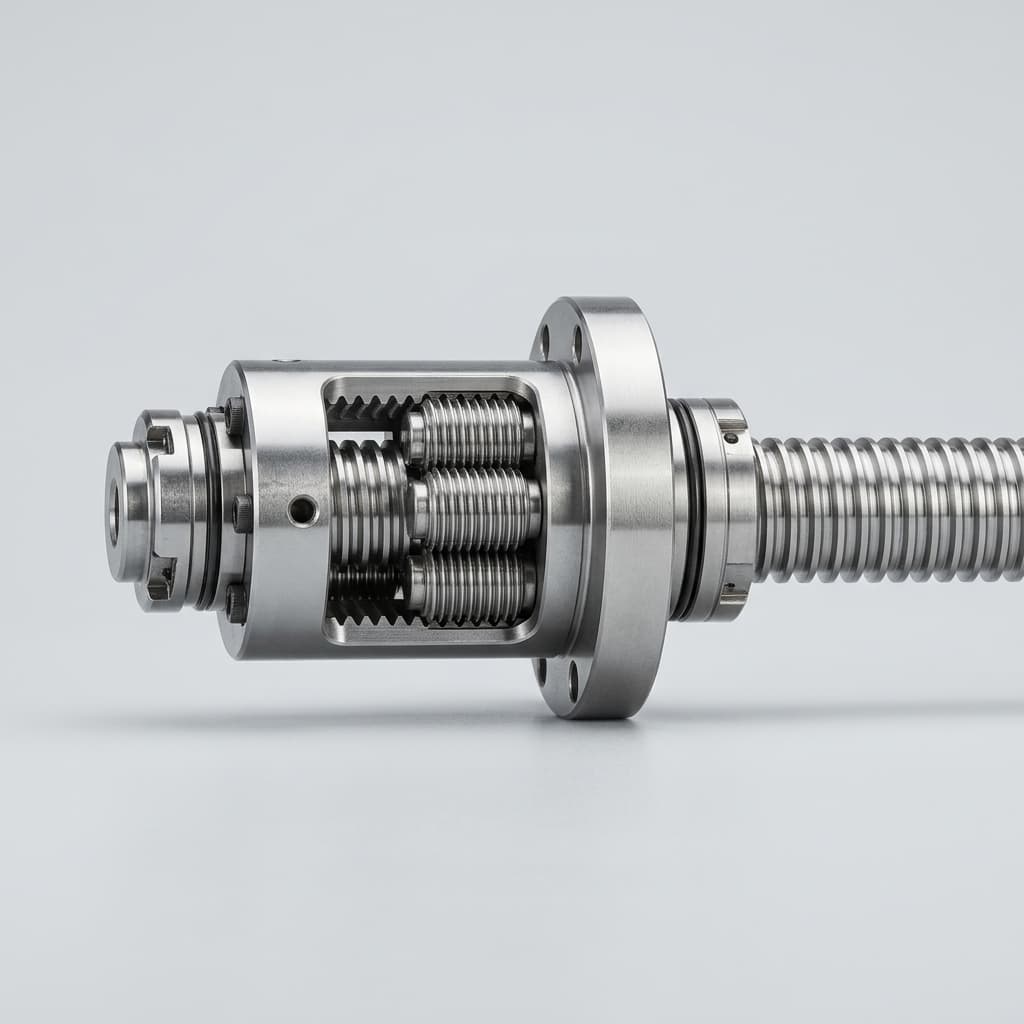
In a standard planetary roller screw, the threaded rollers are housed entirely inside the nut.
- The Mechanism: The rollers orbit the central threaded screw shaft. Timing gears (synchronizing rings) at the ends of the nut ensure the rollers stay perfectly spaced and do not migrate axially relative to the nut as they rotate.
- The Motion: Typically, the screw shaft is rotated by a servo motor via a coupling or belt drive, and the nut translates linearly along the shaft.
- Application Shape: This design requires a long, fully threaded screw shaft to cover the entire required stroke length. Because the nut translates along the shaft, a secondary hollow rod (the thrust tube) is often attached to the nut to push the external load, while the entire assembly is enclosed in an outer housing.
Inverted Planetary Roller Screw (IPRS)
The inverted design completely reverses this mechanical relationship, moving the synchronizing elements from the nut to the screw shaft.
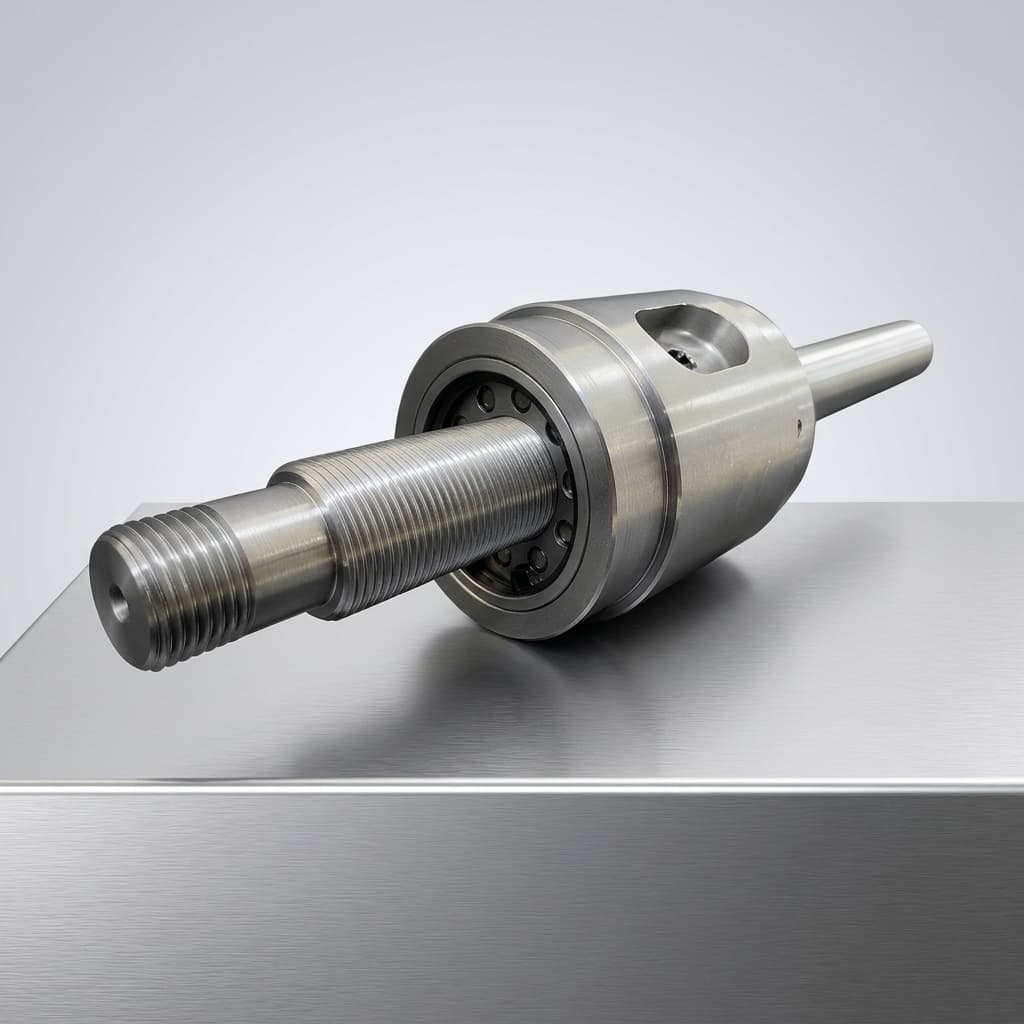
- The Mechanism: The rollers still orbit the threaded screw shaft, but they translate inside an elongated, internally threaded nut. The synchronizing gears are machined directly onto the ends of the threaded portion of the screw shaft.
- The Motion: The nut (which is typically a long, hardened steel tube) is rotated by the motor. In highly integrated designs, the motor's rotor magnets are bonded directly to the outside of this nut. The screw shaft—which only has threads matching the short length of the rollers—translates linearly in and out of the nut.
- Application Shape: The screw shaft acts directly as the actuator's pushrod. Only the section inside the nut needs to be threaded; the rest of the shaft extending out of the actuator can be completely smooth, hollow, or customized with specific mounting threads (like a clevis or trunnion).
Integration Tip: If your mechanical design requires a rod to extend and retract directly from a fixed housing (visually resembling a traditional hydraulic cylinder), an Inverted Roller Screw drastically simplifies the mechanical assembly by allowing the motor magnet to be mounted directly onto the rotating nut, eliminating parallel gearboxes.
2. Deep Dive: When to Specify Standard Planetary (PRS)
Standard planetary roller screws are the heavy-duty workhorses of massive industrial linear motion. Because the internal threads are located on the nut (which is short) and the external threads are on the shaft (which is long), the manufacturing process is highly optimized and well-established.
Engineering Advantages
- Maximum Stroke Length: Because precision thread grinding on an external shaft can be performed on very long CNC grinding machines, standard PRSs can be manufactured for continuous strokes exceeding 3 to 5 meters.
- Superior Hardening and Metallurgy: It is significantly easier to achieve deep, uniform case hardening (via induction hardening or carburizing) on the external threads of a screw shaft than on the internal threads of a long tube. This often translates to slightly higher dynamic load ratings (C) and longer predictable L₁₀ fatigue life for extreme applications.
- Cost-Effective Sizing for Length: For long strokes, a standard PRS is generally more cost-effective to manufacture than an inverted model, simply because grinding long external threads is a faster and more economical process than grinding long internal threads.
Ideal Application Scenarios
- Steel mill equipment, heavy continuous casting machines, and massive forging presses.
- Large-scale plastic injection molding machines (specifically for the main clamping axes where stroke and force are both high).
- Long-stroke factory automation, gantry systems, and heavy material handling elevators.
3. Deep Dive: When to Specify Inverted (IPRS)
The inverted architecture was born out of a critical aerospace and robotics need for extreme compactness, weight reduction, and reduced inertia in high-performance actuators. By turning the nut into the rotating element, engineers can wrap the motor directly around the nut, merging two components into one.
Engineering Advantages
- Compact Footprint (High Force Density): An IPRS actuator is significantly shorter overall than a standard PRS actuator of the exact same stroke length. Because the screw shaft acts directly as the pushrod, there is no need for a secondary extension tube to enclose a translating nut. The dead-length (the part of the actuator that does not contribute to the stroke) is minimized.
- Customizable Pushrod and Superior Sealing: Since the screw shaft only needs threads where the planetary rollers sit, the extended portion of the rod can be manufactured completely smooth. This makes it incredibly easy to integrate standard industrial rod seals and wipers, preventing the ingress of water, dust, and abrasive contaminants (achieving IP67 or IP69K ratings easily).
- Reduced Inertia and High Dynamics: For highly dynamic, fast-reversing applications, integrating the motor rotor directly onto the nut eliminates the need for flexible couplings, timing belts, and external gearboxes. This reduces total system inertia, eliminates backlash from secondary drive components, and drastically improves the tuning response and bandwidth of the servo control loop.
Ideal Application Scenarios
- Aerospace flight control actuators (flaps, ailerons, landing gear deployment).
- Humanoid robots, robotic joints, and advanced powered exoskeletons where space and weight are at an absolute premium.
- Automotive spot welding guns, compact riveting machines, and high-speed compact servo presses.
- Direct drop-in replacements for hydraulic cylinders in mobile equipment.
4. Comparative Engineering Matrix
Use the following comprehensive table to objectively compare the two architectures when making procurement, sizing, and architectural decisions. Note that both options far exceed the capabilities of ball screws.
| Evaluation Criteria | Standard Planetary (PRS) | Inverted Planetary (IPRS) |
|---|---|---|
| Primary Motion Profile | Nut translates linearly along the shaft | Screw shaft translates linearly inside the nut |
| Total Actuator Footprint | Longer (requires housing for stroke + thrust tube) | Extremely Compact (shaft = pushrod, motor wraps nut) |
| Maximum Feasible Stroke Length | Very High (> 3 to 5 meters possible) | Moderate (limited by long internal thread grinding) |
| Thread Hardening Depth & Quality | Deep & Uniform (External induction/carburizing) | Shallower (Internal hardening challenges in long tubes) |
| Environmental Sealing Capability | Harder to seal external threads without bellows | Easy (Smooth pushrod accepts standard hydraulic wiper seals) |
| Dynamic Load Rating (C) | Highest theoretical capacity for a given diameter | Extremely high, but generally 10-15% lower than PRS |
| Inertia and Dynamic Response | Moderate (Motor requires coupling/belt to drive shaft) | Excellent (Direct drive / Integrated Motor eliminates couplings) |
| Thermal Management | Heat dissipates along the long exposed screw shaft | Motor heat transfers directly into the nut and grease |
| Cost Profile and TCO | Lower manufacturing cost per meter of stroke | Higher precision required, higher initial unit cost |
The ranges and directionality in this matrix are intended for early architecture screening. Final selection still depends on the selected supplier's catalog series, lead, diameter, preload class, lubrication package, bearing arrangement, mounting stiffness, and duty-cycle thermal model.
5. Load Capacity, Lifespan, and Manufacturing Nuances
The expected life of any roller screw is defined by the L₁₀ calculation, which relies heavily on the Dynamic Load Rating (C) and the surface hardness of the raceways. The difference in manufacturing between PRS and IPRS creates important nuances.
The Internal Grinding and Hardening Challenge
In an IPRS, the nut can be as long as the entire stroke of the actuator. Heat treating and precision-grinding internal threads over a 1-meter tube is a significant metallurgical and machining challenge. The grinding wheel must reach deep inside the tube while maintaining micron-level precision and avoiding chatter. As a result, the internal threads may have a slightly shallower case hardness depth compared to the highly accessible external threads of a standard PRS.
The Impact on Procurement and Sizing
If an application demands 100% of the maximum theoretical load life for decades of continuous 24/7 operation at peak force, a standard PRS is the mathematically safer choice. However, because both designs offer dynamic loads vastly superior to ball screws (often 2x to 3x higher), the IPRS usually has more than enough capacity for high-shock applications like riveting and pressing, provided it is properly sized by an application engineer. Do not simply swap a PRS for an IPRS of the same diameter without recalculating the L₁₀ life.
6. Thermal Management Considerations
One of the most critical engineering differences between the two designs is how they handle heat.
- Standard PRS Heat Dissipation: In a standard setup, the long screw shaft is exposed to the air inside the housing, acting as a large heat sink. Heat generated by friction at the nut can radiate outwards along the shaft.
- Inverted IPRS Heat Concentration: In an integrated IPRS actuator, the stator coils of the servo motor are wrapped directly around the rotating nut. This means heat from the motor and heat from screw friction are concentrated in the exact same location. If driven at a high duty cycle without proper thermal modeling, the combined heat can quickly degrade the grease viscosity, leading to premature wear. High-performance IPRS actuators often require liquid cooling jackets or specialized high-temperature synthetic greases to mitigate this risk.
7. Engineering & Procurement Selection Checklist
Before issuing a Request for Quote (RFQ) or finalizing a mechanical CAD model, engineering and procurement teams should run through this decision checklist to avoid costly over-specification or premature failures:
- Are there strict spatial or footprint constraints? (If the actuator must fit into a tight space, lean strongly toward Inverted).
- Is the required stroke length greater than 1 meter? (If yes, lean toward Standard Planetary due to manufacturing limits of IPRS).
- Will the actuator operate in a dirty, wet, or washdown environment? (Inverted allows for easier IP67/IP69K rod sealing on the smooth shaft extension).
- Is an integrated motor design preferred for dynamic response? (Inverted allows direct rotor mounting on the nut, eliminating backlash).
- Is the primary goal the lowest initial unit cost for a long-stroke application? (Standard Planetary is more economical to manufacture at length).
- Have you accounted for thermal limits? (If using an IPRS at >50% duty cycle, verify that a cooling strategy or high-temp grease is specified).
- Have you verified the dynamic load requirements against the specific L₁₀ life curve of the chosen screw type? (Do not assume an IPRS and PRS of the exact same diameter have identical load ratings; always check the specific manufacturer data).
Minimum RFQ / Supplier Communication Fields
When contacting a supplier to request a quote for either a Standard or Inverted Roller Screw, ensure you provide the following critical spec dimensions and boundary conditions to avoid miscommunication and ensure accurate sizing:
- Application Boundary: Peak dynamic load (kN) vs. continuous operating load (kN)
- Speed Profile: Maximum linear speed (mm/s) and typical operating speed
- Duty Cycle & Dwell: Percentage of time moving vs. stationary (essential for thermal modeling, especially for IPRS)
- Stroke Limits: Working stroke (mm) vs. maximum mechanical stroke (mm)
- Environmental & Failure Risks: Presence of abrasive dust, washdown chemicals, or extreme temperatures (to dictate IP rating, wiper selection, and lubrication)
- Mounting Interface: Clevis, trunnion, or front flange (affects dead length and buckling calculations)
8. Frequently Asked Questions (FAQ)
1. Does an Inverted Roller Screw require different lubrication?
It often does. Because the motor is integrated directly around the long nut of an IPRS, the heat from the stator transfers into the nut, raising the operating temperature. Furthermore, distributing grease along a long internal thread is more difficult than swiping it along an external thread. Specialized synthetic greases that maintain viscosity at higher temperatures are usually required.
2. Are both types resistant to high shock loads?
Yes. Both PRS and IPRS rely on "line contact" from the threaded rollers, meaning they distribute shock loads across a massive surface area. This makes both types highly resistant to brinelling (the permanent indenting of raceways) compared to "point-contact" ball screws. This is why both are excellent for servo presses and riveting guns.
3. Can I achieve the same leads (pitch) in both designs?
Generally, yes. Both designs support a wide variety of leads (from ultra-fine 2mm up to high-speed 40mm+). However, because the timing gears in an IPRS are cut into the translating screw shaft rather than the nut, specific diameter-to-lead ratios may be constrained by gear module manufacturing limitations. Your supplier will advise on available combinations.
4. Which is better for replacing a traditional hydraulic cylinder?
An Inverted Roller Screw (IPRS) is visually and mechanically the closest drop-in replacement for a hydraulic cylinder. The screw shaft mimics the smooth hydraulic rod, extending and retracting cleanly from a sealed housing. This makes integration into existing clevis, trunnion, and flange mounts incredibly straightforward without redesigning the machine's geometry.
9. Sources and References
To ensure accurate engineering specifications, the principles and design constraints outlined in this guide are derived from the following industry standards, technical papers, and engineering references:
- SKF Planetary Roller Screws: Planetary roller screws - Manufacturer reference for standard planetary roller screw product architecture and industrial positioning.
- SKF Inverted Roller Screws: Inverted roller screws - Manufacturer reference for the inverted roller screw category used in compact actuator layouts.
- Curtiss-Wright Actuation Products: Actuation products - Supplier reference for electromechanical actuation product families where roller screw selection is part of broader actuator architecture.
Need Help Sizing Your Next Electromechanical Actuator?
Choosing between standard planetary and inverted roller screws dictates the structural footprint, control dynamics, and longevity of your entire machine. If you are replacing a hydraulic cylinder, designing a compact servo press, or dealing with extreme space constraints, our engineering team can provide precise L₁₀ life calculations and advanced thermal modeling.
Start by reviewing our full range of Planetary Roller Screw Actuators, or Contact Engineering Support with your specific application's load, speed, duty cycle, and spatial constraints for a custom sizing recommendation.
Author

Categories
More Posts
Planetary Roller Screw Actuators in Servo Press Applications: Sizing and Selection
Learn why planetary roller screw actuators are commonly specified for servo press machines. We cover force distribution, shock tolerance, and key sizing parameters for precision joining and forming.
How to Audit and Select a Planetary Roller Screw Manufacturer: A 2026 Procurement Guide
Audit planetary roller screw manufacturers in 2026: verify load ratings, grinding control, testing proof, lead-time risk, TCO, and RFQ package readiness.
How to Specify Condition Monitoring and Predictive Maintenance (PdM) for Roller Screw Actuators
A comprehensive guide for procurement and engineering teams on specifying temperature, vibration, and force sensors for predictive maintenance in roller screw actuators.