
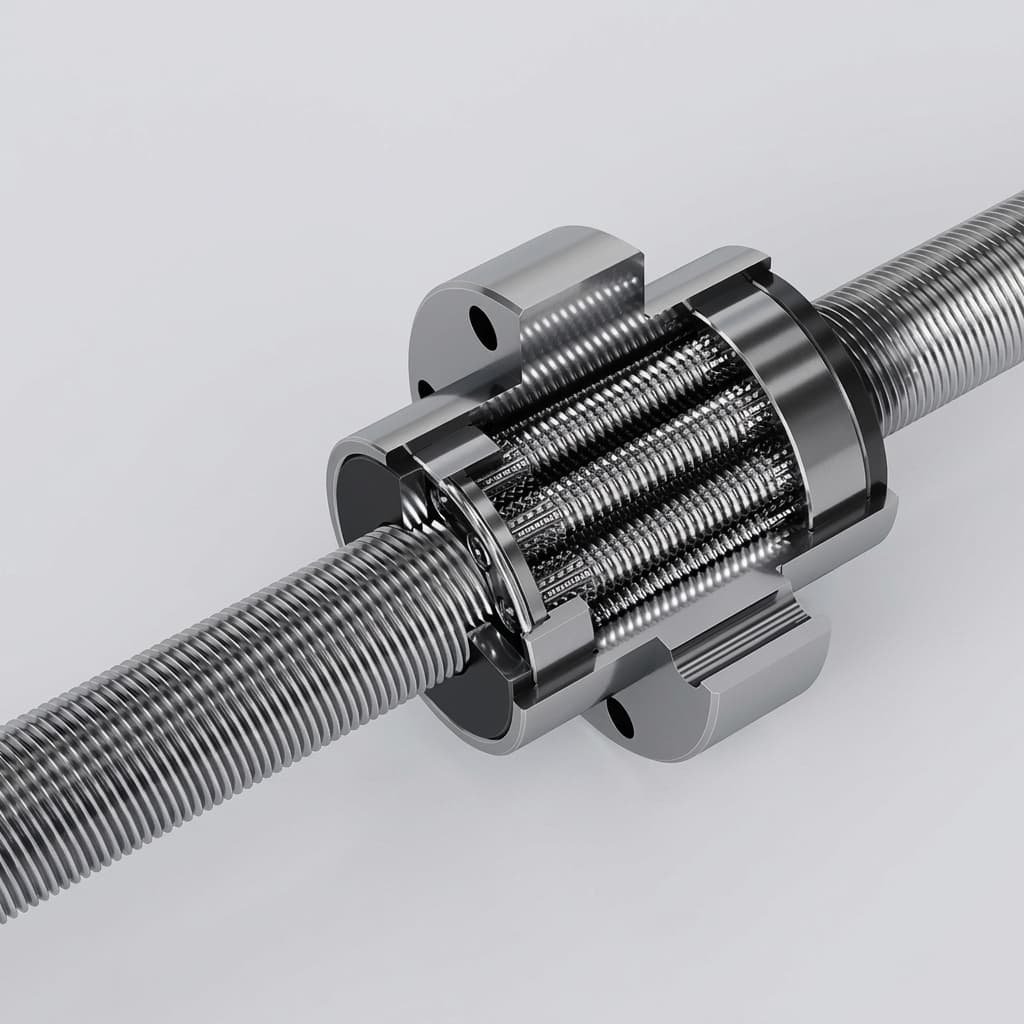
Specifying Roller Screw Actuators for Continuous Duty (S1) Applications: Thermal Management and Sizing Guide
Sizing roller screw actuators for S1 continuous duty: RMS force, thermal derating, cooling options, lubrication risks, and RFQ checks for engineers.
When heavy industry replaces hydraulic cylinders with electromechanical solutions, the planetary roller screw actuator is the undisputed first choice. Offering exceptional force density, rigidity, and fatigue life, it is the only mechanical technology capable of enduring the punishing loads previously reserved for fluid power. However, there is a silent killer in the transition from hydraulics to electromechanics: Thermal Failure under Continuous Duty.
For procurement teams and design engineers, sizing an actuator solely on "peak force" for a high-duty-cycle application is a guaranteed path to catastrophic failure, severe downtime, and warranty disputes.
Bottom Line Up Front (BLUF): Planetary roller screws generate significant friction due to the large number of contact points between the rollers and the screw shaft. In an S1 (100% Continuous) duty cycle, this friction translates into immense heat. If the heat generation exceeds the actuator's thermal dissipation capacity, the internal lubricant will break down, leading to rapid mechanical wear and system failure. Specifying for continuous duty requires evaluating Root Mean Square (RMS) force, thermal limit curves, and active cooling options before finalizing an RFQ.
This comprehensive guide explores the intersection of thermal management, duty cycle ratings, and procurement strategies. It is designed to help buyers, sourcing managers, and engineers specify roller screw actuators that can truly run 24/7 without burning up.
Published: July 26, 2026. Scope: global industrial applications using electric rod-style or integrated planetary roller screw actuators under S1 continuous-duty assumptions. Limitations: final sizing still requires the supplier's validated thermal model, motor data, ambient-temperature assumptions, lubrication interval, and application-specific duty-cycle profile.
1. The Core Problem: Why Duty Cycle Matters More Than Peak Force
When a procurement team receives a request from engineering for an actuator that can push 50 kN (11,200 lbf), the immediate instinct is to source an actuator with a dynamic load rating exceeding 50 kN.
While that is necessary, it is completely insufficient if the actuator operates constantly.
The Illusion of Peak Force
Peak Force (F_p) is the maximum force an actuator can exert momentarily. It is usually limited by the mechanical yield strength of the screw, the bearings, or the peak torque limit of the servo motor. However, momentary bursts of high force do not define the thermal stress on the system.
The Reality of Continuous Force
Continuous Force (F_c), or RMS Force, is the steady-state force an actuator can maintain indefinitely without exceeding its maximum allowable temperature rise (typically winding temperature in the motor and grease temperature inside the screw housing).
If an application requires pushing 50 kN once every hour, heat is a non-issue. If the application requires pushing 20 kN back and forth, continuously, for 24 hours a day, the heat generated by the screw and the motor will accumulate. Without adequate cooling, the internal temperature will exceed the limit of the synthetic grease (often around 120°C to 150°C, though oxidation begins much earlier).
Procurement Pitfall: Do not accept quotes from suppliers who only validate peak force against your load requirements. Demand a thermal model or an RMS force calculation that proves the actuator will survive your specific duty cycle.
2. Defining S1 Continuous Duty in Electromechanical Systems
Duty cycle is commonly expressed as a percentage of "on" time versus total cycle time. Duty Cycle (%) = (Time_on) / (Time_on + Time_off) * 100
However, in industrial motor and actuator classifications (per IEC 60034-1), duty cycles are categorized into specific regimes:
- S1 - Continuous Running Duty: The actuator operates at a constant load for a sufficient time to reach thermal equilibrium. There are no rest periods. This is a true 100% duty cycle.
- S2 - Short-Time Duty: Operation under constant load for a short time, followed by a rest period long enough for the actuator to cool down to ambient temperature.
- S3 to S8 - Intermittent Periodic Duty: Various cycles involving starting, running, electrical braking, and resting.
When specifying a roller screw actuator for S1 Duty, you are demanding that the manufacturer guarantee the thermal equilibrium of the device will not exceed the safe operating limits of its internal components. This is the most demanding specification you can write.
3. Understanding the Thermal Limit (The Performance Envelope)
To successfully procure a continuous-duty actuator, buyers and engineers must understand the "Performance Envelope" or "Continuous Operating Curve."
The ability of an actuator to deliver continuous force is heavily dependent on its speed. At low speeds, friction is lower, and the system can deliver higher continuous force. At high speeds, friction heat skyrockets, drastically reducing the allowable continuous force.
Below is a schematic representation of a typical roller screw actuator's thermal and mechanical limits.
Analyzing the Curve
- The Red Dashed Line: Represents the mechanical limits of the screw or the peak torque of the drive. The actuator can only reach this zone for short bursts.
- The Blue Solid Line (S1 Thermal Limit): Represents the boundary for continuous operation. Notice how the allowable force drops significantly as speed increases.
- The Overheating Zone: Operating continuously above the blue line will cause the actuator to overheat, break down the grease, and fail.
4. Calculating RMS Force and Speed (The Engineer's Requirement)
To prove to a supplier that you understand your application—and to force them to quote responsibly—your RFQ must include the Root Mean Square (RMS) calculations for your motion profile.
RMS calculations provide a "time-weighted average" of the force and speed over the entire cycle.
F_rms = sqrt( (F1^2 * t1 + F2^2 * t2 + ... + Fn^2 * tn) / t_total )
Where:
- F_n = Force during segment n
- t_n = Time duration of segment n
- t_total = Total cycle time (including dwell/rest times)
When sourcing, the supplier's application engineer must plot your F_rms and V_rms (RMS Speed) on the actuator's performance curve. If the point falls outside the "Safe Continuous Operating Zone," you have three choices:
- Oversize the Actuator: Buy a physically larger actuator with a larger surface area and a larger screw to dissipate heat and lower stress. (Increases cost and footprint).
- Change the Lead: Select a screw with a different lead (mm/rev) to optimize the motor's speed/torque ratio, bringing the application back into the safe thermal zone.
- Implement Active Cooling: Add liquid cooling to extract the heat from the stator and the screw housing.
5. Cooling Strategies for High-Duty Roller Screws
When you cannot simply buy a larger actuator due to space or budget constraints, active cooling becomes mandatory for S1 duty cycles. Procurement must evaluate a supplier's ability to provide integrated cooling solutions.
Here is a structured comparison of thermal management strategies for roller screw actuators:
| Cooling Strategy | Description | Typical Heat Dissipation | Application Scenario | Cost Impact |
|---|---|---|---|---|
| Passive Convection | Heat dissipates through the aluminum extrusion housing into ambient air. | Low | Intermittent duty (< 50%), well-ventilated environments. | Base Cost (None) |
| Larger Frame / Thermal Mass | A larger actuator body and screw spread heat across more material and surface area. | Low to Moderate | Borderline S1 applications where footprint and mass increases are acceptable. | ++ $$ |
| Finned Housing / Heat Sink | External fins increase surface area so passive or fan-assisted airflow removes more heat. | Moderate | Continuous motion at moderate force where washdown or guarding still allows airflow. | ++ $$ |
| Forced Air (Fan) | An external electric fan blows ambient air across cooling fins on the actuator body. | Moderate | 50% - 75% duty cycle, high ambient temperature environments. | + $ |
| Liquid Cooling (Water/Glycol) | Integrated water jackets around the motor stator and thrust bearing housing extract heat. | Very High | S1 (100%) duty cycle, heavy presses, injection molding, continuous stamping. | +++ $$$ |
| Oil Bath / Circulating Oil | The planetary roller screw is flooded with circulating oil through an external heat exchanger. | Maximum | Ultra-high force, continuous extreme speed operations (rare, highly specialized). | +++++ $$$$$ |
Procurement Tip: If your application requires Liquid Cooling, ensure your facility actually has a chilled water or water/glycol loop available at the machine installation site. If a standalone chiller is required, the total cost of ownership (TCO) will increase significantly.
6. Lubrication Breakdown: The Real Bottleneck
Why do we care so much about heat? Because heat destroys lubrication.
Planetary roller screws have immense surface contact area. Unlike ball screws (which have point contact), roller screws have line contact across multiple threaded rollers. This allows them to handle shock loads and extreme forces, but it creates massive shear friction in the grease.
When a roller screw actuator overheats during S1 operation, the synthetic base oil separates from the thickener in the grease. The oil leaks out, leaving behind a hard, dry, clay-like substance that provides zero lubrication. Once this happens, metal-on-metal contact begins, micro-welding occurs, and the screw is destroyed within hours.
Specifying Lubrication for S1
For continuous duty, standard off-the-shelf NLGI Grade 2 lithium grease is often insufficient. Your specification should demand:
- High-Temperature Synthetic Grease: Ask for greases formulated with PAO (Polyalphaolefin) or PFPE (Perfluoropolyether) base oils capable of withstanding continuous 120°C to 150°C operation.
- Automated Lubrication Ports: S1 actuators consume grease rapidly. Specifying an actuator with integrated Zerk fittings and plumbing it to an automated progressive lubrication system is critical for survival.
7. Procurement & Engineering Decision Matrix
When specifying for S1 continuous duty, buyers and engineers must evaluate multiple dimensions before releasing an RFQ. Use this decision matrix to align your requirements with the correct actuator configuration.
| Decision Parameter | Engineering Requirement | Procurement Checkpoint | Supplier Communication (RFI/RFQ) | Failure Risk (If Ignored) |
|---|---|---|---|---|
| Duty Cycle Definition | Define motion profile & dwell times to confirm true S1 (100%) operation. | Verify supplier is not quoting a peak-force (S2/S3) rated model. | "Please provide a thermal derating curve based on 100% duty." | Immediate overheating; motor winding burnout. |
| RMS Force Calculation | Calculate F_rms across the entire cycle (not just peak force). | Compare supplier's continuous thrust rating against F_rms. | "Does this model support our F_rms of [X] kN indefinitely?" | Grease breakdown; rapid mechanical wear and galling. |
| Thermal Management | Determine if passive, forced air, or liquid cooling is required. | Audit facility for chilled water loop availability if liquid cooled. | "Include pricing for integrated water cooling jackets." | Thermal expansion causing bearing lockup. |
| Lubrication System | Specify PAO/PFPE synthetic grease for high-temp operation. | Confirm auto-lube compatibility doesn't void warranty. | "Specify the recommended relubrication interval and grease type." | Dry running; catastrophic screw failure within hours. |
| Operating Environment | Define ambient temp, contamination (IP rating), and shock loads. | Ensure IP65/IP67 seals are included if running in harsh conditions. | "Are the rod seals rated for [X]°C ambient at continuous speeds?" | Contaminant ingress destroys roller threads. |
| Lead and Gear Ratio | Optimize screw lead (mm/rev) to keep motor in optimal torque/speed range. | Evaluate total cost of ownership (TCO) vs. buying a larger frame size. | "Can we optimize the screw lead to avoid liquid cooling?" | Motor operates inefficiently; excess heat generation. |
8. The S1 Duty Actuator Sourcing Checklist
Before sending an RFQ to manufacturers like SKF, Exlar, or Tolomatic for a continuous-duty actuator, ensure your procurement and engineering teams have completed this checklist:
- Complete Motion Profile Defined: Have you mapped out every move, dwell, extend, and retract segment in milliseconds?
- RMS Calculations Provided: Have you provided the F_rms (Continuous Force) and V_rms (Continuous Speed) to the supplier?
- Ambient Environment Specified: What is the maximum ambient temperature around the machine? (An actuator rated for S1 duty at 20°C will overheat at 45°C).
- Thermal Model Requested: Have you explicitly requested the supplier to provide a thermal model or continuous performance curve with your application plotted on it?
- Cooling Viability Checked: If liquid cooling is proposed by the supplier, has your facility confirmed the availability of a cooling loop?
- Lubrication Maintenance Interval Quoted: Has the supplier provided a calculated re-lubrication interval based on your specific duty cycle (not just generic catalog data)?
- Auto-Lube Compatibility: Is the actuator designed to accept an automated lubrication system without voiding the warranty?
9. Frequently Asked Questions (FAQ)
What is the typical lead time for a liquid-cooled roller screw actuator compared to a standard model?
Liquid-cooled configurations are rarely kept in stock and usually require custom machining for the water jackets. Expect a lead time of 12 to 16 weeks compared to the 6 to 8 weeks typical for standard passive-cooled models. Plan your procurement cycles accordingly.
Can I just use a standard ball screw instead of a roller screw for S1 duty?
If the loads are very light, yes. However, for high forces, ball screws suffer from rapid fatigue and spalling under continuous duty. Planetary roller screws offer up to 15 times the fatigue life of equivalent-sized ball screws, making them the only viable choice for high-force S1 applications.
Our hydraulic cylinder runs 24/7. Why is the electromechanical equivalent overheating?
Hydraulic cylinders are fundamentally immune to internal friction heat generation because the hydraulic fluid itself acts as a coolant, constantly circulating heat back to a massive reservoir and heat exchanger. Electromechanical actuators retain all friction heat locally inside the screw and motor housing unless actively cooled.
What is the maximum safe operating temperature for a roller screw actuator?
While it varies by manufacturer and grease selection, as a rule of thumb, the internal temperature of the screw nut should not exceed 80°C to 90°C for optimal grease life. The motor windings can typically handle up to 130°C (Class F or H insulation), but heat transfer to the screw must be managed.
How much does liquid cooling add to the cost of the actuator?
Integrated water cooling jackets typically add 15% to 30% to the base cost of the actuator. However, this is significantly cheaper than having to buy an actuator that is two frame sizes larger just to get enough passive thermal mass.
10. Conclusion & Next Steps
Specifying a roller screw actuator for an S1 continuous duty cycle is one of the most challenging tasks for modern mechanical engineering and procurement teams. Ignoring the thermal realities of electromechanical friction will result in catastrophic failure. By focusing on RMS force, demanding thermal models from suppliers, and proactively planning for liquid cooling and automated lubrication, you can ensure your transition from hydraulics is permanent and profitable.
Need help sizing an actuator for a punishing duty cycle? Do not leave your machine's uptime to chance. Contact our engineering team today with your motion profile, and we will perform a comprehensive thermal and fatigue life analysis to specify the exact planetary roller screw actuator your application demands.
→ Request an Engineering Consultation and RFQ
11. Sources & References
Author

Categories
More Posts
Planetary vs. Inverted Roller Screws: Engineering Differences and Selection Guide
Compare planetary vs inverted roller screws for actuator footprint, load life, sealing, thermal limits, and RFQ inputs. Use the checklist before sourcing.
How to Write an RFQ for a Roller Screw Actuator: Sizing, Specs, and Procurement Guide
Use this roller screw actuator RFQ guide to specify load, motion profile, duty cycle, life, environment, and supplier questions before procurement review.
Planetary Roller Screw Actuators in Servo Press Applications: Sizing and Selection
Learn why planetary roller screw actuators are commonly specified for servo press machines. We cover force distribution, shock tolerance, and key sizing parameters for precision joining and forming.