
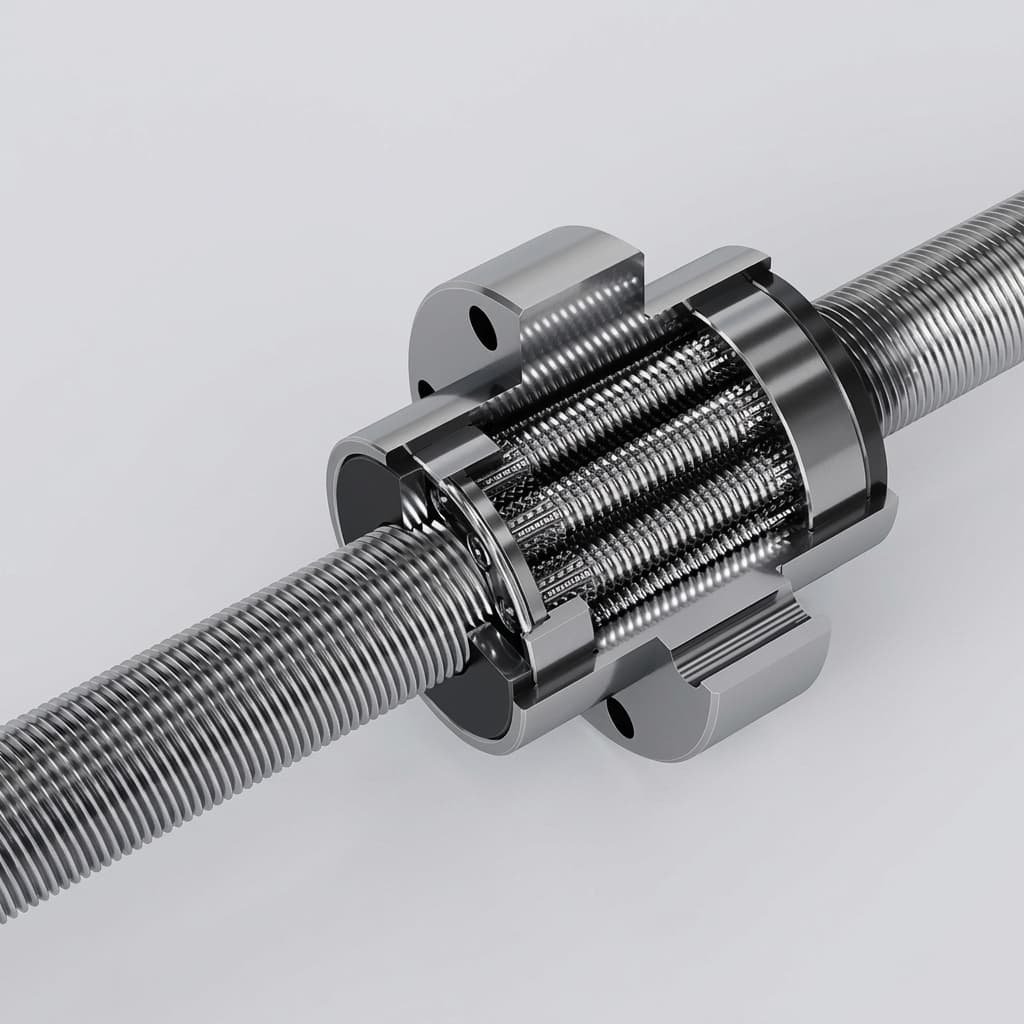
How to Specify Condition Monitoring and Predictive Maintenance (PdM) for Roller Screw Actuators
A comprehensive guide for procurement and engineering teams on specifying temperature, vibration, and force sensors for predictive maintenance in roller screw actuators.
As industrial automation pushes toward higher duty cycles, heavier loads, and zero-downtime manufacturing, the planetary roller screw actuator has become the gold standard for heavy-duty linear motion. However, despite their massive fatigue life advantages over standard ball screws, roller screws are not invincible. When subjected to continuous shock loads, harsh environments, or improper lubrication, they will eventually wear out.
For decades, maintenance teams have relied on preventive maintenance, swapping out actuators based on rigid time schedules or theoretical $L_10$ life calculations. But in 2026, replacing a perfectly good USD 15,000 electromechanical actuator just because it hit an arbitrary hours-run milestone is an unacceptable waste of capital. Conversely, waiting for it to fail catastrophically can halt an entire production line, where downtime often dominates the repair cost.
The solution is Predictive Maintenance (PdM) driven by real-time condition monitoring.
For buyers, procurement teams, and integration engineers, the challenge is no longer deciding if you need predictive maintenance, but knowing exactly what to specify in your Request for Quote (RFQ). Specifying "smart actuator" is too vague. You must dictate the sensor architectures, the communication protocols, and the data parameters required.
This comprehensive guide breaks down the degradation modes of roller screw actuators, details the precise sensors required to monitor them, and provides a strict procurement framework for sourcing condition-monitored linear motion systems.
(Last Updated: July 24, 2026)
Scope and limits (Global, July 2026): This guide applies to planetary roller screw actuators used in industrial electromechanical axes, servo presses, high-force automation, and hydraulic-replacement projects. It focuses on specifying temperature, vibration, force, position, and drive-current monitoring for the actuator assembly; it does not replace manufacturer load-life calculations, lubrication compatibility review, safety risk assessment, or validated machine acceptance testing. Treat the thresholds and cost ranges below as RFQ planning inputs that must be calibrated against a healthy baseline from the actual machine.
1. The Gap Between L10 Theoretical Life and Shop-Floor Reality
Every reputable roller screw manufacturer provides an $L_10$ life estimate. This metric, derived from ISO standards originally developed for rotary ball bearings, calculates the number of millions of revolutions (or kilometers of travel) that 90% of a group of identical roller screws will endure before the first signs of metal fatigue (spalling) appear.
While $L_10$ is an essential metric for the initial mechanical sizing during the engineering phase, it is practically useless for daily maintenance planning.
Why? Because $L_10$ calculations assume ideal, sterile conditions:
- Perfect and continuous lubrication.
- Absolute axial alignment with zero side-loading.
- Ambient temperatures within strict laboratory parameters.
- No ingress of dust, coolant, or washdown chemicals.
In real-world pressing, stamping, welding, or machining applications, these ideal conditions rarely exist. A seal might tear, allowing water to emulsify the grease. A misaligned trunnion mount might introduce severe radial loads. A change in the product recipe might increase the required pressing force by 15%, drastically increasing the RMS (Root Mean Square) load.
When reality deviates from the engineering assumptions, the actual lifespan of the actuator diverges wildly from the $L_10$ estimate. Predictive maintenance closes this gap by measuring the physical reality of the actuator in real-time, calculating the Remaining Useful Life (RUL) based on actual stress rather than theoretical models.
2. Key Degradation Modes in Planetary Roller Screws
To understand what sensors to buy, you must first understand how a planetary roller screw actually fails. Unlike hydraulic cylinders, which typically fail due to seal degradation and fluid leaks, electromechanical roller screws fail mechanically. The primary degradation modes include:
Surface Fatigue (Spalling)
This is the natural end-of-life for any rolling-element bearing or screw. Repeated cyclic stress causes microscopic cracks below the surface of the screw threads. Over time, these cracks propagate to the surface, causing small flakes of metal (spall) to break away. Once spalling begins, friction increases exponentially, leading to rapid catastrophic failure.
Lubrication Breakdown or Starvation
Planetary roller screws have multiple points of rolling and sliding contact (the rollers against the nut, and the rollers against the screw shaft). They require specific high-pressure greases or constant oil baths. If the temperature exceeds the grease's dropping point, the base oil separates from the thickener, and the mechanism runs dry. This causes severe galling and scoring of the threads.
Brinelling (Shock Load Deformation)
If the actuator experiences a shock load that exceeds its static load rating ($C_0$), the rollers will dent the screw threads. This permanent plastic deformation creates a rough spot that generates severe vibration every time the nut passes over it, rapidly accelerating fatigue wear.
Contamination Ingress
If the wiper seals fail, particulate matter (metal shavings, dust) or fluids (coolant, water) enter the nut assembly. Particulates act as a grinding compound, rapidly wearing down the thread profiles and increasing backlash (play) in the system.
Predictive maintenance sensors are designed to detect the early warning signs of these specific failure modes weeks or months before the actuator jams or loses positioning accuracy.
3. Core Sensor Technologies for Condition Monitoring
When specifying a condition-monitored actuator, procurement must mandate specific hardware. Below is a structured breakdown of the sensor technologies used to monitor roller screw health, what they detect, and their relative cost impact.
| Sensor Type & Location | Primary Parameter Monitored | Detected Failure Modes | Data Processing Requirement | Cost Impact | Criticality for PdM |
|---|---|---|---|---|---|
| Accelerometers (Mounted on Nut Housing) | High-frequency vibration and shock pulses | Micro-spalling, brinelling, bearing defects, severe contamination | High (Requires Fast Fourier Transform / FFT analysis) | High | Essential |
| Thermocouples / RTDs (Mounted on Nut or Motor Base) | Ambient housing temperature and thermal gradients | Lubrication breakdown, overload conditions, excessive duty cycle | Low (Simple threshold monitoring and trend lining) | Low | Essential |
| Servo Current Transducers (Inside Servo Drive) | Motor current draw / torque output | Increased friction due to wear, binding, or lack of lubrication | Medium (Requires filtering out normal cycle fluctuations) | Included (Leverages existing drive data) | High |
| Linear Encoders (External to Actuator) | Absolute position accuracy and backlash | Thread wear, nut wear, coupling slippage | Medium (Compares commanded position vs. actual position) | Medium | Medium |
| Load Cells / Force Transducers (On Rod End) | Actual applied force vs. commanded force | Mechanical binding, application process changes | Low (Direct analog or digital output) | High | Medium |
| Acoustic Emission Sensors (Housing) | Ultrasonic frequencies (>20 kHz) | Extremely early-stage subsurface cracking, severe lubrication loss | Very High (Requires specialized edge computing hardware) | Very High | Optional (For hyper-critical aerospace/defense only) |
Procurement Tip: Do not pay for redundant sensors if your servo drive can provide the data. Most modern servo drives can output high-resolution current (torque) data via EtherCAT or PROFINET. If you trend the current required to execute a standard empty-stroke cycle over time, a gradual increase in current is a highly reliable indicator of increasing internal friction.
4. Sensor Placement and System Architecture
The effectiveness of vibration and temperature monitoring relies entirely on sensor placement. Placing a temperature sensor on the outer aluminum extrusion of the actuator body will yield heavily delayed and muted data compared to placing it directly on the planetary nut housing.
When drafting an RFQ, specify that the actuator housing must be machined with dedicated ports or mounting pads for sensor integration.
Getting the Data Out: IO-Link vs. Analog
When purchasing hardware, specify the communication protocol. Avoid raw analog outputs (4-20mA or 0-10V) for advanced vibration sensors, as they require expensive analog input cards on your PLC. Instead, specify IO-Link enabled sensors. IO-Link provides a standardized digital point-to-point connection that handles parameterization, diagnostics, and process data over standard unshielded cables, drastically reducing integration costs for your controls engineers.
5. The Cost-Benefit Analysis for Procurement
Integrating predictive maintenance hardware increases the upfront capital expenditure (CapEx) of the actuator. Procurement teams must justify this cost.
A high-quality industrial IO-Link accelerometer, an RTD temperature probe, and the necessary machined mounting ports typically add USD 800 to USD 1,500 to the cost of the actuator assembly. Treat this as a planning range only; stainless washdown sensors, hazardous-area ratings, edge gateways, and supplier-specific validation packages can move the quote outside that range.
How do you justify this premium?
- Elimination of Secondary Damage: If a roller screw jams at full speed, the shockwave often destroys the expensive servo motor and rips the trunnion mounts out of the machine frame. PdM detects the wear before the jam occurs, saving the motor and the frame.
- Optimized Inventory Costs: You do not need to keep a USD 15,000 spare actuator sitting in a warehouse "just in case." With RUL tracking, you order the replacement actuator exactly when the system says you have 6 weeks of life remaining, aligning with supplier lead times and freeing up working capital.
- Scheduled Maintenance Windows: In high-throughput plants, unplanned downtime can outweigh the replacement actuator cost within minutes. Swapping an actuator during a planned Sunday maintenance shift costs a fraction of an emergency shutdown on a Tuesday afternoon.
For an RFQ review before supplier release, start by collecting the stroke, load, speed, duty cycle, ingress exposure, and available PLC or drive protocols in the engineering sizing checklist. That same data determines whether current-plus-temperature monitoring is enough, or whether vibration and force sensing should be factory-installed.
6. Procurement Specification Checklist for Smart Actuators
Do not leave the condition monitoring architecture open to supplier interpretation. Attach this checklist to your RFQ to ensure you receive quotes for hardware that your IT and controls teams can actually use.
- Sensor Mounting Provisions: Actuator housing must include machined flat pads and tapped holes (e.g., M8 or M12) located directly over the nut travel path for future accelerometer and temperature probe mounting.
- Temperature Monitoring: Supplier must provide a factory-installed RTD or PT100 temperature sensor positioned to monitor the internal ambient temperature of the nut assembly.
- Vibration Monitoring: Supplier must provide an IO-Link compatible piezoelectric accelerometer capable of multi-axis vibration measurement.
- Data Accessibility: The system must not lock data into a proprietary, black-box cloud system. All raw sensor data (vibration, temperature, current) must be accessible locally via standard industrial protocols (EtherCAT, PROFINET, Ethernet/IP, or OPC UA).
- Baseline Data Delivery: Supplier must perform a factory acceptance test (FAT) and provide the baseline "healthy" vibration and current signatures in the final documentation package, so your software has a starting point for anomaly detection.
7. Frequently Asked Questions (FAQ)
Do I need specialized machine learning software to use these sensors?
Not necessarily. While advanced AI models are excellent for calculating exact Remaining Useful Life, you can achieve 80% of the value simply by setting threshold alarms in your PLC. For example, if the baseline operating temperature is 45°C, you can program the PLC to trigger a warning at 60°C and an automatic machine halt at 75°C.
Can I retrofit sensors onto my existing roller screw actuators?
Yes, but with limitations. You can epoxy accelerometers to the outside of an existing actuator body, but the vibration signals will be dampened by the air gap and the outer extrusion. Factory-machined sensor ports that probe deeper into the housing provide vastly superior signal-to-noise ratios.
Which is more important: Temperature or Vibration monitoring?
If you have severe budget constraints, start by tracking Servo Drive Current (free) and Temperature (cheap). A sudden spike in temperature is the most reliable indicator of lubrication starvation. Vibration monitoring (expensive) is critical if you need to detect the earliest stages of mechanical spalling weeks before failure.
Do IP69K washdown environments affect sensor selection?
Absolutely. If the actuator operates in a food processing or pharmaceutical environment subject to high-pressure washdown, all external sensors and cables must also be IP69K rated and constructed of 316 stainless steel. Standard IP67 sensors will fail rapidly.
8. Sourcing Intelligent Actuation Systems
Transitioning from reactive maintenance to predictive maintenance fundamentally changes the economics of heavy-duty linear motion. By specifying the correct condition monitoring hardware in your initial RFQ, you empower your maintenance teams to see inside the mechanics of the actuator, turning unpredictable mechanical wear into a scheduled, managed process.
However, interpreting the data and selecting the right sensor package for your specific duty cycle requires deep application engineering. A sensor package that works for a slow-moving hydraulic replacement might not sample fast enough for a high-speed servo press.
If your procurement or engineering team is evaluating an upgrade to smart electromechanical actuators, our application engineers can help you define the exact sensor architecture, communication protocols, and baseline metrics required for your specific machine.
References
- SKF, Predictive maintenance - used for the maintenance-strategy framing around condition monitoring and planned intervention.
- IO-Link Community, IO-Link technology - used for the digital sensor communication recommendation in the IO-Link section.
- Bosch Rexroth, Predictive maintenance for linear motion technology - used for the linear-motion condition-monitoring context.
Author

Categories
More Posts
Roller Screw vs. Ball Screw: Which Linear Actuator is Right for Your Application?
A comprehensive engineering comparison of roller screws and ball screws, focusing on load capacity, lifespan, speed, and typical use cases in industrial automation.
How to Audit and Select a Planetary Roller Screw Manufacturer: A 2026 Procurement Guide
Audit planetary roller screw manufacturers in 2026: verify load ratings, grinding control, testing proof, lead-time risk, TCO, and RFQ package readiness.
How to Write an RFQ for a Roller Screw Actuator: Sizing, Specs, and Procurement Guide
Use this roller screw actuator RFQ guide to specify load, motion profile, duty cycle, life, environment, and supplier questions before procurement review.