
Roller Screw vs. Ball Screw: Which Linear Actuator is Right for Your Application?
A comprehensive engineering comparison of roller screws and ball screws, focusing on load capacity, lifespan, speed, and typical use cases in industrial automation.
When designing a high-performance linear motion system, you have to choose between a ball screw and a planetary roller screw. Both convert rotary motion to linear motion, but their internal mechanics dictate different limits.
Here are the mechanical differences, performance metrics, and cost considerations to help you select the right actuator and avoid over-specification.
1. Architectural Differences: Contact Mechanics
The fundamental difference between these two technologies lies in their contact geometry.
The Ball Screw Mechanism
A ball screw uses recirculating steel balls traveling within the helical raceway between the screw shaft and the nut.
- Contact type: Point contact.
- Load distribution: The balls make point contact with the raceways. The load is concentrated on a small surface area, creating high localized Hertzian contact stress.
The Planetary Roller Screw Mechanism
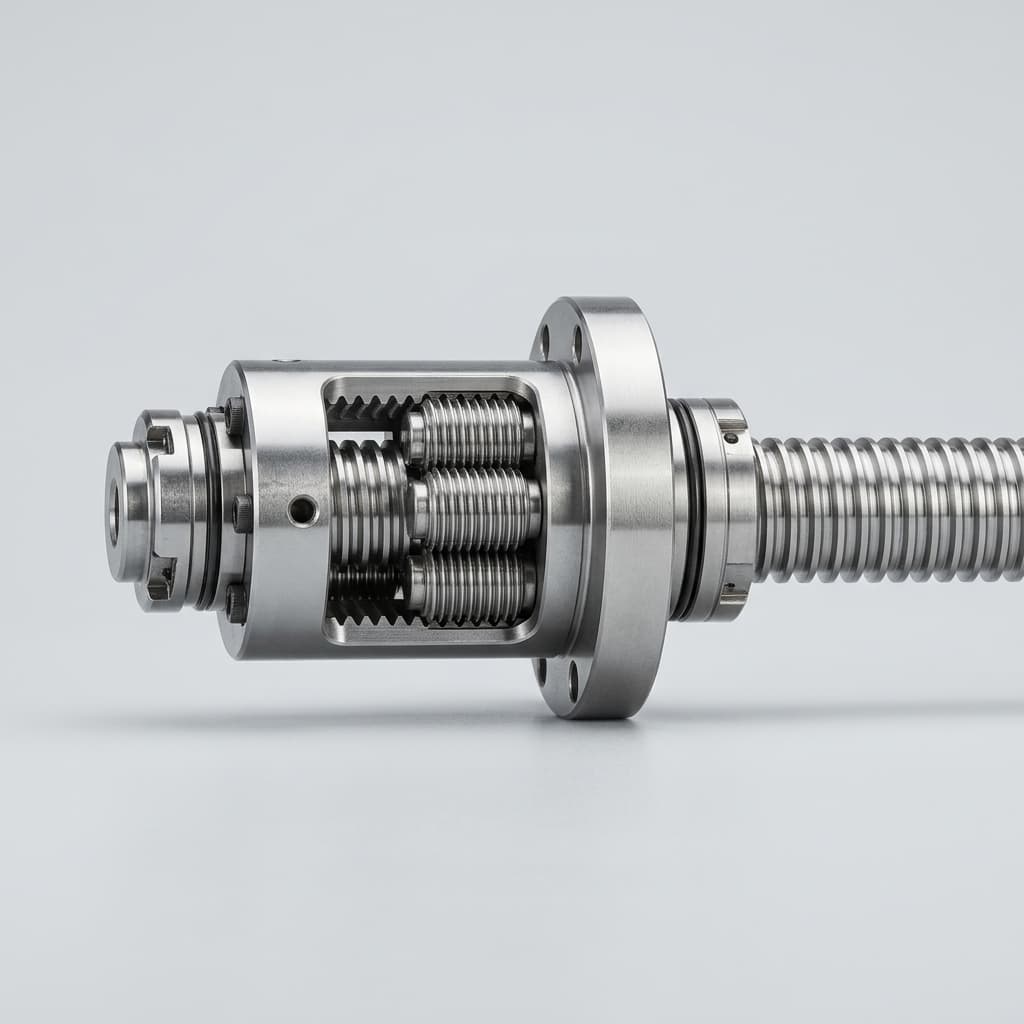
Instead of recirculating balls, a planetary roller screw uses a set of threaded rollers spaced evenly around the screw shaft, constrained by planetary gears.
- Contact type: Line contact.
- Load distribution: The rollers engage the nut and screw threads over a much larger surface area, providing multiple points of line contact simultaneously.
Rule of Thumb: For a given thread diameter and pitch, a planetary roller screw can provide substantially more contact area than a comparable ball screw. This often translates to higher load capacity and stiffness when lubrication, alignment, and preload are controlled.
2. Load Capacity and Lifespan (L₁₀ Calculation)
The difference in contact geometry directly impacts the dynamic load rating (C) and the expected L₁₀ life of the actuator.
- Dynamic Load Capacity (C): Roller screws often provide higher dynamic load capacity than similarly sized ball screws, sometimes approaching 2 to 3 times depending on design. If your application involves heavy pressing, stamping, or injection molding, roller screws can provide the required force density without an oversized envelope.
- Lifespan Impact: The L₁₀ life equation dictates that life is proportional to the cube of the dynamic load rating.
The standard life equation is:
L₁₀ = ( C / Pm )³ × 10⁶ revolutions
(Where C is the dynamic load rating and Pm is the equivalent dynamic load).
Because the dynamic load rating (C) is cubed, doubling the load rating results in 2³ = 8 times the lifespan in the simplified equation. In real actuator selection, the useful life gain still depends on lubrication, mounting alignment, preload, contamination, thermal limits, and the actual load spectrum.
3. Speed, Acceleration, and the DN Limit
Ball screws are limited by the speed at which the balls can safely recirculate through the return tubes. At high rotational speeds, the balls can collide with each other or the return mechanism, causing premature wear or catastrophic jamming. This physical limit is expressed as the DN value (Diameter × RPM).
Roller screws do not rely on recirculating elements. The rollers remain captive and synchronized in their planetary arrangement, rotating in continuous engagement.
- Ball Screw max speed limit: Typically DN ≈ 100,000 to 150,000.
- Roller Screw max speed limit: Often supports higher DN values and acceleration rates, with the practical limit set by screw design, lubrication, support bearings, and actuator balance.
4. Shock Tolerance and Axial Rigidity
In applications like servo presses or hydraulic cylinder replacements, the actuator is often subjected to sudden shock loads at the end of the stroke.
- The point contact of a ball screw makes it susceptible to brinelling, which means permanent indentations in the raceway caused by impact loads. Once brinelled, the screw can become noisy and wear quickly.
- The line contact and larger thread engagement of a roller screw distribute shock loads over a wider area, improving axial rigidity and impact resistance when the actuator is sized and mounted correctly.
5. Quick Comparison Matrix
| Feature | Ball Screw | Planetary Roller Screw |
|---|---|---|
| Contact Geometry | Point Contact | Line Contact |
| Dynamic Load Capacity | Base (1x) | High (2x to 3x) |
| Expected Lifespan | Base (1x) | Higher when load, lubrication, and alignment are controlled |
| Max Acceleration | Moderate, design dependent | High, design dependent |
| Shock Tolerance | Lower in impact-heavy applications | Higher when sized and mounted correctly |
| Relative Cost | Lower Initial Cost | Higher Initial, Lower TCO |
6. Buyer Selection Inputs
Before choosing a screw architecture, capture the operating window rather than only the target force. These inputs help prevent both undersizing and unnecessary over-specification:
| RFQ Input | Why It Matters |
|---|---|
| Rated force, peak force, and shock load | Separates normal working load from short overload events. |
| Stroke, speed, acceleration, and duty cycle | Drives screw lead, motor speed, RMS load, and thermal review. |
| Required life, cycle count, or L10 assumption | Connects dynamic load rating to a measurable service target. |
| Backlash, stiffness, repeatability, and axial play | Determines preload, inspection scope, and control-loop behavior. |
| Mounting, side load, anti-rotation, and guide design | Protects the screw from bending loads and misalignment. |
| Environment and lubrication access | Controls contamination, heat, grease interval, and maintenance planning. |
For product-level options, compare the roller screw actuator, planetary roller screw actuator, and servo electric cylinder pages before sending final specifications.
7. Backdriving and Self-Locking
A critical safety and control consideration in linear motion is backdriving—the ability of an applied axial load to turn the screw shaft when the motor is unpowered.
- Ball Screws: Due to their very low friction, ball screws backdrive easily. If holding a vertical load during a power loss, a failsafe brake, rod lock, counterbalance, or other safety device should be specified.
- Planetary Roller Screws: While still efficient, the larger contact area creates slightly more internal friction. However, they can still backdrive under load. Never rely on a roller screw to self-lock. Like ball screws, a holding strategy is normally required for vertical or safety-critical applications.
8. Manufacturing Complexity and Tolerances
The cost disparity between these technologies is rooted in their manufacturing processes. Many commercial ball screws are manufactured via thread rolling—a fast, cold-forming process that produces economical screws with acceptable tolerances for general automation.
In contrast, precision planetary roller screws are typically manufactured with thread grinding for the screw shaft, the nut's internal threads, and the threaded rollers. The timing of the planetary gears at the ends of the rollers must also be synchronized so the rollers travel through the nut without binding. This manufacturing process supports high load capacity, but it usually dictates a higher initial price.
9. Cost vs. Total Cost of Ownership (TCO)
Planetary roller screws have a higher initial procurement cost due to the precision CNC thread grinding required.
However, when evaluating TCO for high-duty-cycle equipment, roller screws often cost less long-term:
- Reduced maintenance: Eliminates the need for frequent actuator replacements.
- Compact design: Achieving high forces in a smaller footprint saves surrounding structural material.
- Downtime prevention: In automotive or aerospace manufacturing lines, roller screw reliability prevents costly unplanned downtime.
10. Lead (Pitch) Selection Criteria
When specifying either a ball screw or a roller screw, selecting the correct lead (pitch)—the linear distance the nut travels per one full revolution of the shaft—is critical:
- Small Leads (e.g., 2mm to 5mm): Provide immense mechanical advantage (force multiplication) and ultra-high resolution positioning. However, they limit the maximum linear velocity due to the motor's RPM ceiling.
- Large Leads (e.g., 20mm to 40mm): Allow for extremely high-speed linear travel without over-speeding the motor or exceeding the DN limit of the screw. The tradeoff is reduced force multiplication, requiring a higher-torque servo motor or an inline planetary gearhead.
Summary Checklist for Buyers
Specify a Ball Screw if:
- The application has light to moderate payloads (e.g., CNC routers, packaging machines).
- Budget constraints are the primary driver.
- The duty cycle allows for scheduled maintenance and occasional replacement.
Specify a Planetary Roller Screw if:
- You are replacing a hydraulic cylinder.
- The application involves heavy loads, high shock, or continuous 24/7 duty cycles.
- High force density in a compact envelope is strictly required.
- You are designing a servo press, riveting machine, or aerospace flight control mechanism.
If you are currently evaluating actuator architectures for your next project, our engineering team can review load-life assumptions, motor sizing, validation criteria, and manufacturability. Start with the engineering sizing checklist, then contact us with your application parameters for a technical review.
Author

Categories
More Posts
Planetary vs. Inverted Roller Screws: Engineering Differences and Selection Guide
Compare planetary vs inverted roller screws for actuator footprint, load life, sealing, thermal limits, and RFQ inputs. Use the checklist before sourcing.
How to Write an RFQ for a Roller Screw Actuator: Sizing, Specs, and Procurement Guide
Use this roller screw actuator RFQ guide to specify load, motion profile, duty cycle, life, environment, and supplier questions before procurement review.
Replacing Hydraulic Cylinders with Electromechanical Actuators: A Complete Engineering Guide
Discover why industrial OEMs are shifting from fluid power to electromechanical actuators. We analyze the technical benefits, ROI, and how to successfully size a roller screw actuator for hydraulic replacement.