Specify the clean zone and test conditions
Air classification describes the surrounding environment. Equipment suitability needs its own evidence for the configuration and duty being purchased.
 Roller Screw Actuators
Estimate screw losses and prepare a qualification RFQ for cleanroom or vacuum service.
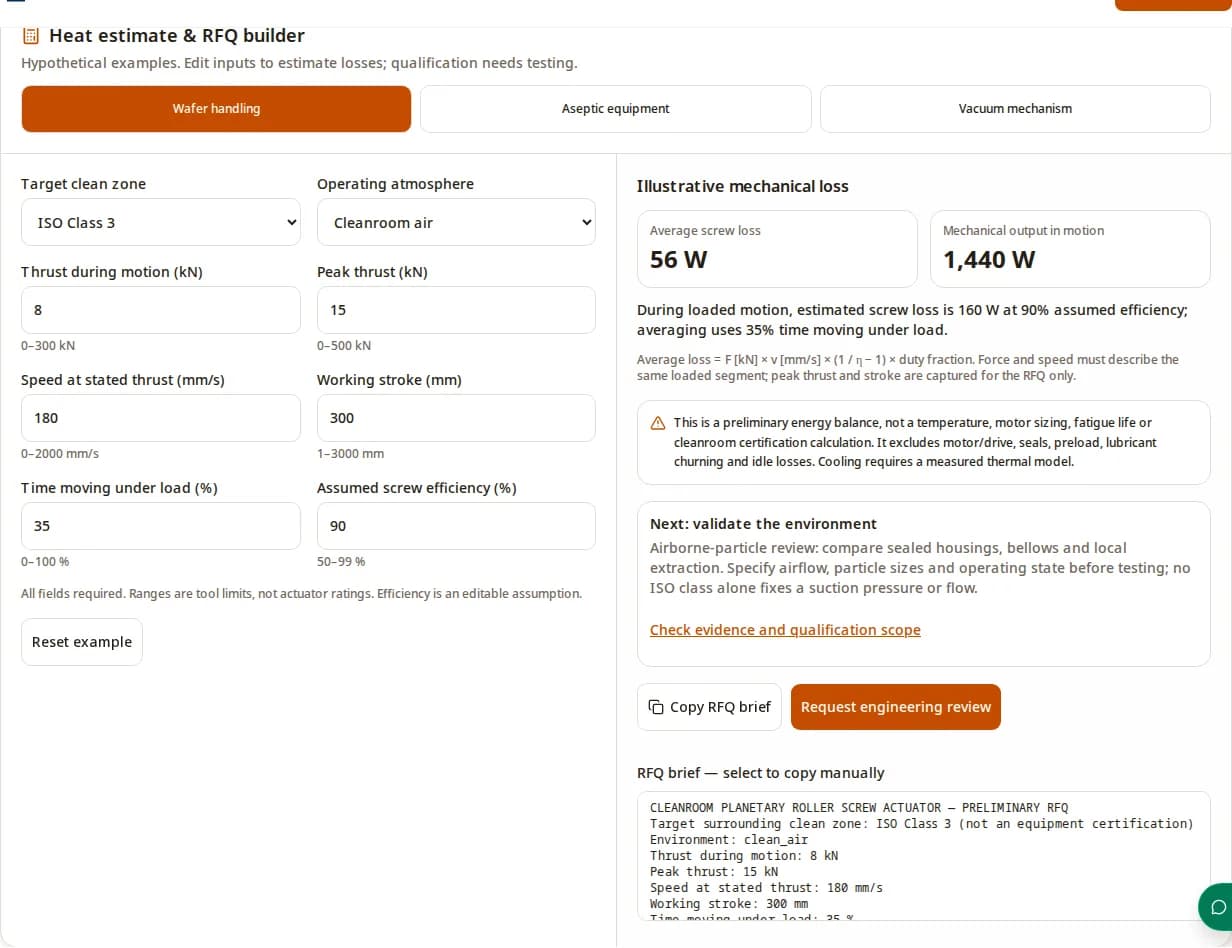
Illustrative inputs; qualification needs testing.
Average screw loss
56 W
Mechanical output in motion
1,440 W
During loaded motion, estimated screw loss is 160 W at 90% assumed efficiency; averaging uses 35% time moving under load.
Average loss = F [kN] × v [mm/s] × (1 / η − 1) × duty fraction. Force and speed must describe the same loaded segment; peak thrust and stroke are captured for the RFQ only.
This is a preliminary energy balance, not a temperature, motor sizing, fatigue life or cleanroom certification calculation. It excludes motor/drive, seals, preload, lubricant churning and idle losses. Cooling requires a measured thermal model.
Airborne-particle review: compare sealed housings, bellows and local extraction. Specify airflow, particle sizes and operating state before testing; no ISO class alone fixes a suction pressure or flow.
Check evidence and qualification scopeAir classification describes the surrounding environment. Equipment suitability needs its own evidence for the configuration and duty being purchased.
A particle count does not establish acceptable gas load or condensable deposits. Request material records and a chamber validation plan where vacuum is involved.
Housing geometry, moving interfaces and material selection need a process-specific assessment. No particle-reduction percentage is claimed for roller screws here.
Fraunhofer IPA — cleanliness-suitable equipment and components
A pharmaceutical application also needs a contamination control strategy, cleanability and decontamination evidence; an ISO class is only part of the specification.
Use the tool to estimate one part of the thermal budget before requesting detailed sizing. It assumes a constant force and speed during the entered loaded-motion fraction. Efficiency is the ratio of screw mechanical output to mechanical input. The 90% default is an illustrative assumption, with no product measurement attached.
| Quantity | Calculation | Result / meaning |
|---|---|---|
| Mechanical output | 15 × 150 | 2,250 W during motion |
| Mechanical input | 2,250 / 0.90 | 2,500 W; motor electrical input is outside this model |
| Screw loss during motion | 2,500 − 2,250 | 250 W |
| Average screw loss | 250 × 0.40 | 100 W; excludes idle and other losses |
| Temperature rise / cooling capacity | Needs thermal resistance, ambient and all heat sources | Unknown; cannot be selected from this result alone |
For varying cycles, calculate each segment separately and average over the complete cycle. Peak thrust and stroke do not enter this simple equation: they remain in the exported RFQ for load, buckling, speed, life and packaging checks. A zero result at standstill does not mean zero holding heat.
A planetary roller screw transfers axial load through threaded rollers between the screw and nut. Its load density can make it a candidate for demanding axes, but the load rating and emission behavior belong to a specific design. Isolate the lubricated mechanism from the process and assess the rod exit, motor interface, cables, bellows and maintenance openings together.
Candidate controls include an enclosed mechanism, a qualified bellows interface, or local extraction routed away from the process. Extraction may alter friction, airflow and gas load; approve the complete layout before testing. Material family names and surface finish alone do not establish suitability. Fraunhofer IPA — cleanliness-suitable equipment and components
| Requirement | What to define | Evidence to request |
|---|---|---|
| ISO Class 1–4 clean zone | Particle sizes, limits, occupancy state, sample locations and operating cycle | Equipment emission report at the required sensitivity; no fixed suction value inferred |
| ISO Class 5–7 clean zone | The same test dimensions, matched to the actual process risk | Report for the supplied assembly, including seals, grease and accessories |
| Grade A / aseptic service | Site contamination strategy, microbial control and decontamination conditions | Qualified integration and cleaning/decontamination evidence; particle class alone is insufficient |
| High-vacuum service | Base/operating pressure, gas species, leak rate and bakeout conditions | Material records plus leak, residual-gas and thermal testing of the assembly |
| Any change after qualification | Seal, lubricant, speed, cable or containment changes | Impact assessment and agreed retest scope |
ISO 14644-1:2015 — air cleanliness classification · ISO 14644-14:2026 — equipment suitability · European Commission — EU GMP Annex 1 (2022), §§2, 4–6
ISO 14644-14:2026 is the current equipment reference checked for this guide. A supplier report citing an older edition is not automatically invalid; compare its method, configuration and acceptance conditions with the new purchase specification. This guide does not prescribe a universal sampling distance, flow rate or test-cycle count.
| Candidate / evidence | Known basis | Still required before approval |
|---|---|---|
| PFPE / PTFE lubricant | Chemours discourages mixing PFPE with non-PFPE grease | Exact grade, viscosity, supplier approval, cleaning procedure and service conditions |
| ASTM E595 material record | NASA reports total mass loss (TML) and collected volatile condensable material (CVCM) | Match identity and conditioning; agree process-specific acceptance limits |
| PTFE / FFKM seal | Material family is a starting point for compatibility review | Compound, fillers, sliding wear and actual VHP/solvent aging evidence: unknown here |
| Stainless rod / DLC coating | Possible surface candidates for an engineered interface | Finish, adhesion, wear debris and lubrication validation: unknown here |
| Complete actuator in vacuum | Individual material records can support screening | Gas load, leak rate, deposits and life under the actual cycle: unknown here |
Outgassing is not zero simply because a lubricant is fluorinated. ASTM E595 data support material screening; they do not establish acceptable deposits on your optics or long-term actuator behavior. Request the relevant record, preparation history and test conditions. NASA Goddard — vacuum outgassing database
A lubricant change needs controlled cleaning and supplier approval. Mixing is discouraged without implying a hazardous reaction. Chemours Krytox — lubricant compatibility FAQ
| Architecture | Reason to evaluate | Tradeoff / verification |
|---|---|---|
| Enclosed planetary roller screw | Compact thrust transmission and controllable motion | Lubrication, seals and heat; confirm ratings and complete-assembly emissions |
| Enclosed ball screw | Candidate where required thrust and stiffness are met | Compare rated capacity, recirculation design and particle test evidence on equal terms |
| Linear motor | Direct drive without a screw transmission | Evaluate holding-current heat, cables and a qualified brake for vertical loads |
| Mechanism outside the critical zone | Reduce exposed internal contamination sources | Motion feedthrough or bellows adds stroke, stiffness and integration constraints |
| Pneumatic actuation | Candidate for simpler motion with suitable air supply | Evaluate exhaust routing, force regulation, air quality and process exposure |
Compare delivered cost over the same service period: hardware, containment, vacuum utilities, cooling, cleaning, qualification and downtime. This guide has no comparable supplier quotes or measured life dataset; request them before calculating a payback.
Add motor, drive, preload, seal and lubricant losses to the modeled screw loss. Define allowable case and process temperatures, ambient conditions and mounting thermal resistance. Compare conduction into the machine with a controlled liquid circuit; validate leaks, condensation and service procedures. Any forced-air arrangement needs approval for the local process airflow. No universal 100 W threshold selects a cold plate.
Vacuum removes the atmospheric convection path. Separate the chamber thermal model from atmospheric extraction design. Ask for temperatures at the nut, bearings and mounting interface under the actual load spectrum, including idle and holding periods.
Missing particle or thermal evidence? Request a qualification-plan review before choosing a configuration.
| Risk | Consequence | Control / alternative |
|---|---|---|
| Using a room class as a product certificate | Unverified emissions at the process boundary | Request the exact equipment report; test a sample before production release |
| Applying atmospheric suction to chamber vacuum | Uncontrolled gas path or pressure mismatch | Have the vacuum engineer approve interfaces; consider external actuation |
| Seal wear or purge toward exposed product | Particle or molecular contamination | Test aged seals and exhaust routing; consider a qualified bellows |
| Ignoring idle, holding or seal heat | Thermal drift or overheating | Measure the full cycle; revise mounting/cooling and motion profile |
| Changing lubricant or decontamination exposure | Wear, residue or chemical damage | Approve grades and cleaning; repeat compatibility and relevant performance checks |
| Underbudgeting qualification and maintenance | Higher project cost and delayed acceptance | Quote test work and replacement intervals alongside hardware |
If evidence is missing, the minimum useful next step is a requirements review and an agreed feasibility test. Treat an untested assembly as unverified; evaluate locating it outside the critical zone if in-process qualification is impractical.
These hypothetical scenarios use the tool presets at 90% assumed efficiency. They are calculated examples, with no customer deployment, measured particle result or regulatory approval implied.
Inputs: 8 kN at 180 mm/s; 35% loaded motion; target ISO Class 3 in air.
1,440 W output → 160 W screw loss in motion → 56 W average.
Next action: Provide the process particle sizes and full cycle; compare containment candidates with equipment emission testing.
Inputs: 25 kN at 120 mm/s; 50% loaded motion; target ISO Class 5 clean zone.
3,000 W output → 333.3 W loss in motion → 166.7 W average.
Next action: Review actual decontamination exposure and the contamination control strategy. This estimate cannot establish Grade A suitability.
Inputs: 12 kN at 60 mm/s; 20% loaded motion; target ISO Class 4 surrounding zone.
720 W output → 80 W loss in motion → 16 W average.
Next action: Specify chamber pressure, leak and gas-load limits separately. Validate material records, pump interfaces and conductive cooling.
By Roller Screw Actuators (RSA) · Published · Reviewed
References checked on . Public standard summaries establish scope; the full applicable standards and project acceptance criteria are needed to commission a test. The model is an energy balance with user assumptions. No proprietary particle test, comparative fatigue dataset or customer case record is available for this page. The editorial owner will review this guide by 1 May 2027, or earlier if a cited standard or the model changes.
Defines air classification by particle concentration. Select the particle sizes and occupancy state; an ISO room class does not certify an actuator.
Current second edition, published February 2026. Addresses equipment suitability by airborne particle concentration; obtain the complete test conditions.
Explains why geometry, materials and process requirements matter beyond air classification. This page supplies no Fraunhofer certificate for a product.
Material-specific ASTM E595 records include TML, CVCM and preparation history. Match the material and conditioning; a database entry is not an assembly vacuum qualification.
Mixing PFPE and other grease is discouraged. It does not imply a hazardous chemical reaction; clean and relubricate according to an approved procedure.
Sterile manufacturing needs a contamination control strategy and qualified equipment/processes. ISO particle class alone does not establish Grade A suitability or sterility.
Use the RFQ builder to capture the motion baseline, then add these unresolved requirements before sending it.
No general particle reduction is established here. Compare complete assemblies under the same motion, load, airflow, lubrication and sampling conditions.
Evaluate it where thrust density, stiffness and motion control matter. Confirm supplier load ratings, life method, maintenance and particle evidence for the actual configuration.
A particle test alone does not demonstrate aseptic suitability. Review microbial control, cleanability, decontamination and integration under the site contamination control strategy.
No. They are hypothetical input examples to demonstrate the energy calculation and RFQ workflow, without measured contamination or service-life outcomes.
Multiply mechanical output F × v by (1 / efficiency − 1), then by the loaded-motion fraction. The result excludes motor, drive, seal, preload and idle losses.
They are RFQ requirements. This simplified model assumes one constant loaded-motion segment. A real cycle needs segment-by-segment forces, speeds, acceleration and idle losses.
No. Only modeled loaded-motion loss is zero. Holding current and other losses can still heat the assembly; thermal testing remains necessary.
No. Lead, inertia, acceleration, load spectrum, preload, buckling, critical speed and cooling are outside this estimate. Send them to the supplier for application sizing.
This page establishes no class-to-port rule. Choose containment or extraction by risk assessment and validate the assembled equipment under the required operating conditions.
They are different design problems. Specify chamber pressure, gas load, leak limits and pump interfaces separately with the vacuum engineer.
Yes. An outward purge may transport internal particles or lubricant vapour toward a sensitive process. Define gas purity and exhaust routing, then test under motion.
No. Require the exact grade, preparation, relevant material test records and assembly validation. Vapour pressure and outgassing depend on conditions and formulation.
Avoid mixing. Chemours advises against mixing PFPE with other greases; use the supplier-approved cleaning and relubrication procedure before reassessment.
Do not assume that from a material family name. Obtain grade-specific compatibility and aging evidence at the actual concentration, temperature and cycle count.
The equipment-suitability reference was checked on 1 November 2026: ISO 14644-14:2026, edition 2. Specify the edition in your test request and assess older reports against it.
Treat suitability as unverified. Request a controlled feasibility test or place the mechanism outside the critical zone with a qualified motion interface before making a production commitment.
Send the RFQ brief plus your particle, vacuum or decontamination criteria. Ask for a proposed configuration and a verification plan before approval.
Inquiry Email
Include force, stroke, speed, duty cycle, life target, quantity, and delivery country.
Send actuator specs to [email protected] or WhatsApp WhatsApp Engineering Support for an engineering review.